

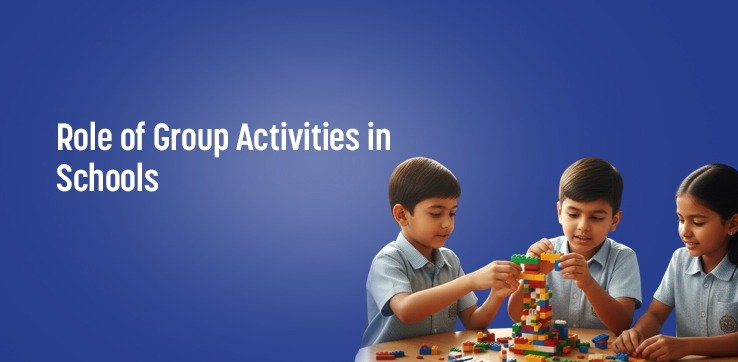
Group activity refers to students working together to explore ideas, solve problems, and complete tasks through collaboration. Such activities could happen either in the classroom or outside it and are expected to have an impact on learning by being interactive and experiential. If you were a teacher or educator, you would probably consider group activities as the best and most effective means of making students go beyond the passive-learning method and, therefore, getting them more deeply involved with the concepts, the other students, the world outside the school, and so on.
Collaboration has been recognised as a major factor contributing to the quality of education in modern learning. Not only do group activities for students improve their understanding of academic subjects, but they also promote socialising, communication, and teamwork as well. This blog is going to give you an insight into the major advantages of group activities, their typical forms, and effective classroom implementation tips.
Benefits of Group Activities for Students
-
Enhanced Communication Skills
Group activities work as a good medium where students feel free to express their minds and also be active listeners. Students through discussions, presentations, and group tasks get to know how to express their mind, respect others’ views and join a good conversation—these are the skills that are necessary not only for academics but also for social life.
-
Improved Social Interaction and Relationship Building
Group activity gives students a chance to develop their social skills by interacting with others. They learn to be patient, understanding, and to treat each other with respect while creating new friendships, which is an overall emotionally healthy process and a feeling of being part of a community that comes along.
-
Development of Teamwork and Leadership Skills
Group activities are not just about the fun and sharing of ideas, but they also require the participants to put their minds together to arrive at one final goal. This kind of environment not only teaches them how to help each other but also how to share the work, and at times even take the lead, which in turn fosters their self-esteem and accountability.
-
Critical Thinking and Problem-Solving
Groupwork is a type of collaboration that requires students to use their critical thinking and problem-solving skills in a united manner. Students sharpen their analytical skills and gain knowledge about handling challenges in an imaginative way, when they put forth different viewpoints and come up with ideas for the solution.
-
Active Learning and Real-World Preparation
Class activities place students in an active learning scenario where they are fully involved. Debates, role-plays, and public speaking are among the activities that help students to face the audience, acquire confidence, and get ready for the academic and business scenarios that involve their professional and academic spheres.
The collaborative skills developed through group activities often extend beyond the classroom and are further strengthened through wider school engagement. To read more visit: Benefits of Participating in School Competitions and Events
Types of Group Activities for Students
- Icebreaker Activities: Easygoing and entertaining introductory games that promote students’ comfort and openness.
- Team-Building Exercises: Activities such as trust games or problem-solving challenges that enable collaboration and trust.
- Collaborative Projects: Group tasks like experiments, presentations, or research projects that require a collective share of responsibility.
- Group Discussions and Debates: Organised talks that promote logical thinking and polite communication.
- Role-Playing and Simulations: Learning by doing that leads to increased imagination, understanding, and even caring for others.
- Creative and Arts-Based Activities: Group art, storytelling, drama, or music projects that stimulate imagination and enhance teamwork.
Implementing Group Activities in the Classroom
The success of group activities greatly depends on the degree of preparedness and the quality of support given to them. Teachers should make it a point to match all the activities with the respective learning goals, confirm that the activities are appropriate for the age and skill level of the students, and finally, establish an atmosphere of encouragement where every student feels that their participation will be valued.
When individuals are given specific roles, like a leader, recorder, or timekeeper, it guarantees that everyone’s contribution is the same. It is necessary for teachers to observe the groups continuously, to provide help whenever necessary, and to give feedback that is aimed at reflecting and improving the students’ collaboration skills.
Conclusion
Group activity for students is a must in an active and engaging learning environment that is created. The inclusion of group activities in the school curriculum not only benefits academic growth but also social and emotional development of the students. Such activities provide students with the opportunity to acquire crucial skills such as strong communication, teamwork, leadership, and problem-solving, thus making them ready for success not only in their education but also in their future career paths.